


When to DOWNsize?


To shorten or not to shorten...? That's the question. The mysterious term "downsize" is popping up more and more often in piercing studios . But what the hell does it mean, and why do some people say you'll die without it?
What is downsize?
DOWNSIZE is the English term for replacing the piercing jewelry with a shorter one in a healing piercing. During the procedure, we use jewelry that's large enough to comfortably accommodate the expected swelling. After a while, however, the swelling subsides, and the piercing post...? It begins to resemble a curtain rod.
However, not in every case.
Downsizing a piercing has nothing to do with brutal cutting, trimming, or shortening with pliers. Downsizing involves REPLACING the entire piercing with a new one—usually titanium, but appropriately shorter. If you have a decorative top or fine jewelry that costs a fortune—no stress, you can replace just the post, and clean and leave the top. The first downsizing usually occurs a few weeks after the piercing. This is when the initial swelling has subsided and the original length of the jewelry is no longer needed, but the channel is still healing. Sometimes, this is just a transitional stage, and the final piercing size will be ready in a few weeks.

When should you change your jewels?
When they start causing more trouble than they’re worth. Seriously, there's no golden date on the calendar when THIS happens. Healing is a process. Some things simply take time, and you can't just rearrange them on your schedule.
Our experience clearly indicates that the most desirable piercings are helix and flat ( scapha ), and everything in between. Close behind are oral piercings, such as tongue or lip piercings . What about the rest? Well, it depends on how you live with them. Sometimes leaving a longer piercing makes cleaning easier, provides some margin for manipulation errors, or simply fits better. Therefore, it may turn out that your belly button doesn't need to be replaced with a shorter one simply because the date indicated in the leaflet has passed. There are piercings that are simply not worth touching until they're fully healed.
Why helix, oh why ?
No other piercing creates such downsizing whining as the helix and its relatives (e.g., flat/scapha ). Why? Because it hates being kneaded, pressed, tugged, or manipulated. And it hates sleeping even more. It's such a poorly placed ear surface that any oversight can result in a nasty bump—a hard, bubble-like lesion around the piercing channel. It's harmless and easily removed, but it looks extremely flimsy and can cause your helix to stand upright like a soldier. And if it's malignant, it can recur.
But what's the point? Why a helix ? Well, the crux of the matter is... pure biophysics. If you press your ear against your head while sleeping, the piercing will begin to settle into a completely unnatural, slightly vertical position. And if this happens during healing, it will almost certainly and very quickly cause a bump . This is nothing unusual – it's the traumatized cartilage's response to repeated stress and pressure. As a result, it creates a kind of cushion on which the piercing sits best. A similar thing happens to wrestling athletes – repeated tugging and trauma to the ears usually results in subtle and multidimensional deformations of the earlobe. Sure, you can live with it, but that's probably not the point of a conscious piercing. The trick is to find the right moment – usually within a few weeks of the procedure.
All other piercings have it much easier. A lobe , conch , or even a rook will never get as badly positioned as a helix . This doesn't mean you can sleep on any fresh piercing, but the biomechanics of this particular piercing perform extremely poorly when tested for prolonged contact with a pillow. Therefore, the first check-up at the studio should be scheduled approximately 3-4 weeks after the procedure.

Mug swells even more.
The world isn't fair. Helix piercings are a real pain in the ass with bumps , nose piercings are quite common, and oral piercings... Well, here we enter a different universe. Generally, lip and inner lip piercings (e.g., tongue , frenulum , or cheek) are performed with jewelry much longer than those for ears or navels . This is primarily due to swelling—here, it's rarely minimal. But! There's a trade-off—beak piercings swell as quickly as they heal. The oral mucosa regenerates incredibly quickly, and sometimes two months is enough for the channel to fully stabilize. What's the deal with this? Your tongue can become loose after just a month, and your snakebites will look like alien antennae. So when should you downsize? When does it become a nuisance—you start biting the post, rubbing it between your teeth, or dramatically losing your accent. If the hole is in good condition, we can change Your jewelry earlier than the official healing date would indicate.
So, is it worth running around in the initiation zone forever? Not necessarily. While each case requires individual consideration, excessively long jewelry in and around the mouth can be detrimental to your teeth, gums, and enamel. The mucous membrane is less likely to develop typical bumps , but it can also cause other problems. Finding the right piercing size can be crucial to maintaining your beautiful smile.
Why do others have it easier?
Physics. The helix is oversized due to the pressure of the pillow and the immediate proximity of the head. Oral piercings need to be shortened, or they'll knock out your first few teeth. But what about other piercings? Well, here's some good news. Nose , nipple, or navel piercings may require downsizing... never. Indeed, the jewelry used for piercings is longer and designed to accommodate swelling, but there's nothing stopping you if the piercing feels good to you and it doesn't damage the surrounding tissues. Leaving a longer post significantly facilitates access and cleaning of the channel, and doesn't pose problems with pushing the jewelry or tightening it. Some people are more talented and have an uncanny ability to snag a fresh piercing on anything within their reach . In such cases, leaving a long post creates an additional safe space for future injuries and recurring swelling.
Therefore, most piercings don't require an urgent change to a shorter post. Helix and its brethren require a downsize quite quickly, but that's all due to the ear cushion. Oral piercing is a separate entity with its own set of problems, while virtually all other piercings can safely wait until fully healed. This includes ear piercings, such as the conch , lobe , upper lobe , rook , or tragus . You can also leave your nostril , septum , or Paoli in place with a clear conscience (and after healing, don't bother with downsizing, just add a decorative hoop or other accessory). The same goes for navels , nipples , and intimate piercings .
What does it look like in practice?
Let's say your helix might need to be downsized after 4 weeks, but if there's still visible swelling or drainage, don't shorten it just because 4 weeks have passed . Conversely, if after 2 weeks the piercing has a noticeable gap, is starting to snag, catch, or irritate, and the piercing is relatively comfortable and stable, you can try shortening the post a little earlier. Of course, this doesn't mean you can happily fiddle with your piercing the next day, claiming it's pain-free and ready for replacement. EVERY piercing requires a few weeks of patience, and I'm sorry, no mercy.
Another problem category is implants and surface piercings . Microdermals or skindivers do not require the traditional reduction of the post length, as in these cases, the jewelry of the target size is installed during the procedure. It is specially designed and embedded in the tissue to cope with even significant swelling.
So who makes the decision? We decide whether to downsize or not... together. If you think your piercing is too long and starting to irritate you (no matter which hole it's in), come on, show yourself, and ask the piercer. You don't have to wait until the healing process is complete or a specific date. If you feel this is the right time, nothing stops you from coming in for a checkup. If it turns out the channel is stable enough to be tampered with, we'll take care of it. If we have any doubts, we'll reschedule. Sometimes, however, the opposite happens: the healing period has officially passed, but long jewelry doesn't bother you. In fact, sometimes it even makes life easier. In such cases, there's no such thing as a "mandatory downsize." However, it's worth stopping by the studio and discussing the matter.
Downsizing is essential in certain situations, but it's not always mandatory. Each case is unique, and we all face different life challenges – so the final decision is always made together.

When to shoot for a deadline?
Below is a list of sample dates where downsizing is worth considering. All dates are provided for guidance only and do not constitute an absolute deadline or a mandatory requirement.
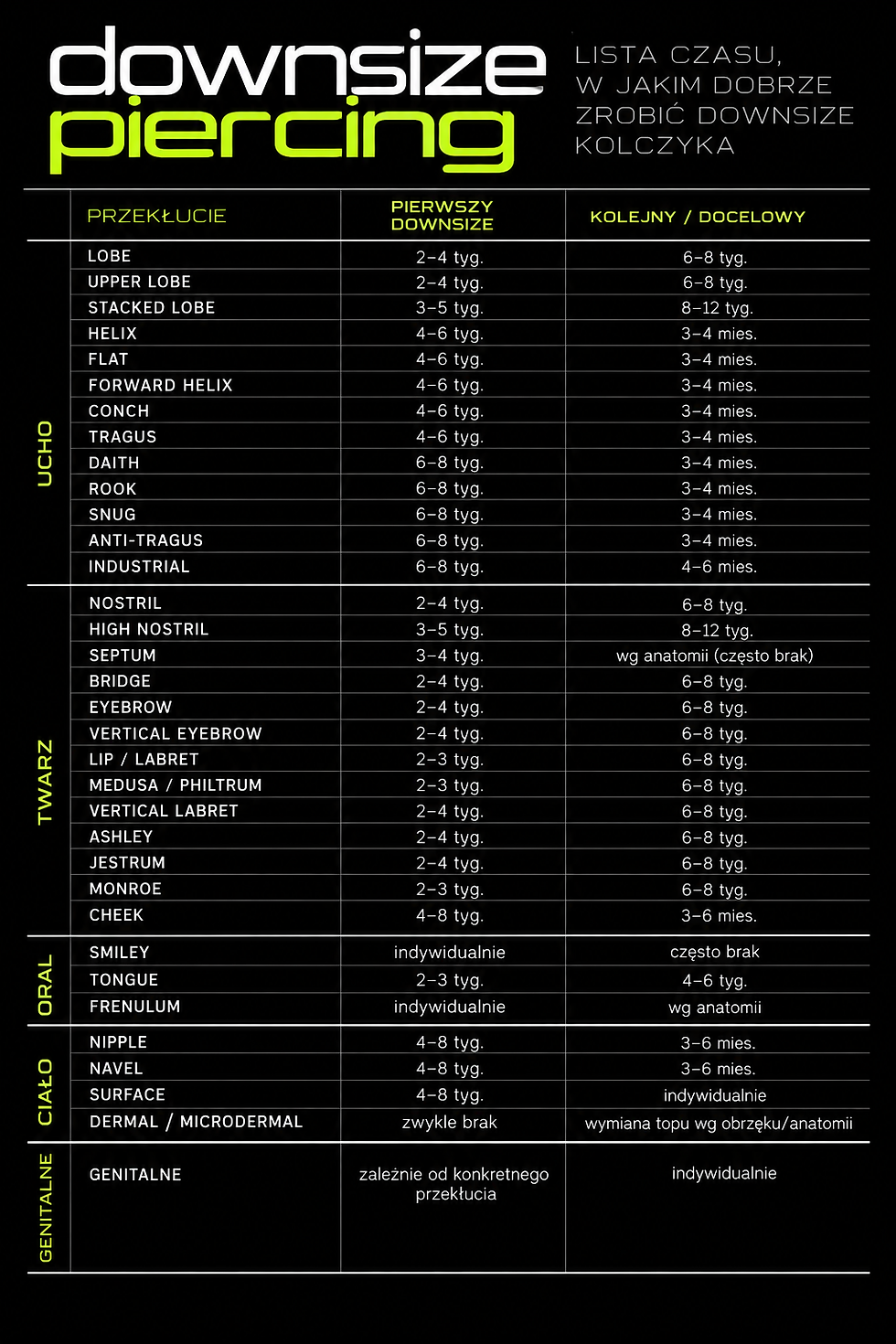
first downsize: 2-4 weeks, next (target): 6-8 weeks
first downsize: 2-4 weeks, next (target): 6-8 weeks
first downsize: 3-5 weeks, next (target): 8-12 weeks
first downsize: 4-6 weeks, next (target): 3-4 months
first downsize: 4-6 weeks, next (target): 3-4 months
first downsize: 4-6 weeks, next (target): 3-4 months
first downsize: 4-6 weeks, next (target): 3-4 months
first downsize: 4-6 weeks, next (target): 3-4 months
DAITH
first downsize: 6-8 weeks, next (target): 3-4 months
first downsize: 6-8 weeks, next (target): 3-4 months
first downsize: 6-8 weeks, next (target): 3-4 months
ANTI-TRAGUS
first downsize: 6-8 weeks, next (target): 3-4 months
first downsize: 6-8 weeks, next (target): 4-6 months
first downsize: 2-4 weeks, next (target): 6-8 weeks
HIGH NOSTRIL
first downsize: 3-5 weeks, next (target): 8-12 weeks
first downsize: 3-4 weeks, next (target): often none
first downsize: 2-4 weeks, next (target): 6-8 weeks
first downsize: 2-4 weeks, next (target): 6-8 weeks
VERTICAL EYEBROW
first downsize: 2-4 weeks, next (target): 6-8 weeks
first downsize: 2-3 weeks, next (target): 6-8 weeks
first downsize: 2-3 weeks, next (target): 6-8 weeks
first downsize: 2-4 weeks, next (target): 6-8 weeks
ASHLEY
first downsize: 2-4 weeks, next (target): 6-8 weeks
JESTRUM
first downsize: 2-4 weeks, next (target): 6-8 weeks
first downsize: 2-3 weeks, next (target): 6-8 weeks
CHEEK
first downsize: 4-8 weeks, next (target): 3-6 months
first downsize: individually., next (target): often none
first downsize: 2-3 weeks, next (target): 4-6 weeks
TONGUEWEB
first downsize: individually., next (target): often none
first downsize: 4-8 weeks, next (target): 3-6 months
first downsize: 4-8 weeks, next (target): 3-6 months
first downsize: none, next (target): none
first downsize: none, next (target): none
first downsize: individually, next (target): individually
Do you have a different opinion?
Do you think you just read the most unrelated sci-fi of your life? Or perhaps you had a completely different experience? Do you think something needs to be added? Is something missing, or do you have a better idea?
Write!
I love constructive discussion and Open Minds! Maybe together we can achieve something even better?
Paula Peszka, Paoli
F-Skin 2.0 EduLITE Academy
contact: paula.lapeszka@gmail.com
Content protected by copyright.
Quoting with source is welcome.
Piercing Geometry Index | downsize piercing | fine jewelry | shortening the jewelry | when to downsize | titanium piercings | what is downsize | is downsize necessary | replacing the piercing | why shorten the piercing | replacing jewelry before it heals | shortening jewelry | when to change an earring | how long does it take for a piercing to heal


Comments